
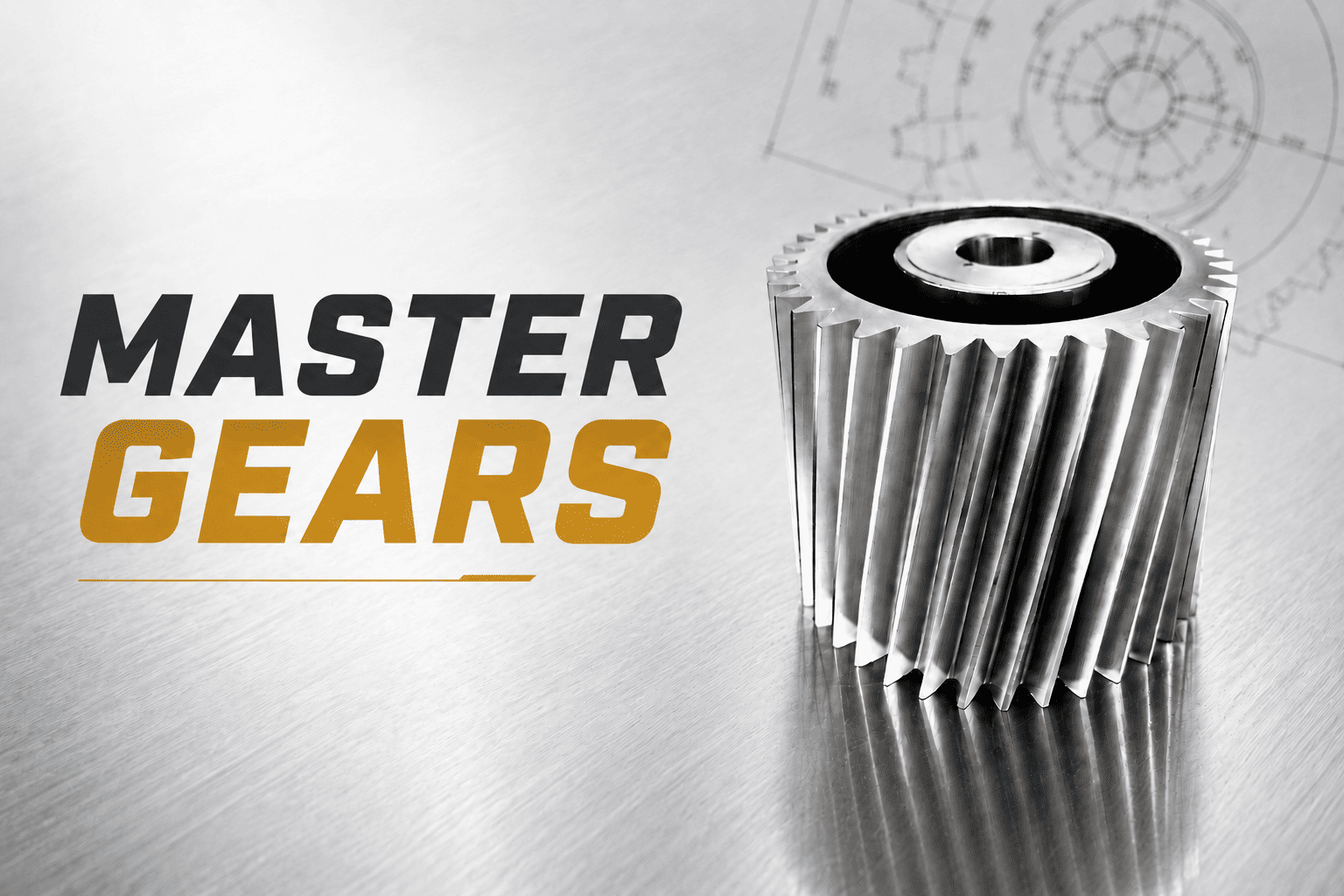
In modern gear manufacturing, quality is ultimately judged not by isolated parameters, but by how a gear performs in mesh. Profile charts and lead graphs provide valuable insights, yet they do not fully represent real operating behavior.
Master gears bridge this gap.
They enable true functional evaluation under rolling conditions, making them indispensable in production environments where performance, consistency, and reliability are non-negotiable.
Master Gears — Definition and Role
Master Gears are ultra-precision gears used as a reference partner in rolling tests to evaluate the functional accuracy of production gears.
They are deployed on:
- Double flank rolling testers
- Single flank gear testing systems
Unlike analytical inspection methods, master gear testing replicates actual meshing conditions, allowing manufacturers to assess cumulative deviations in a single, practical test cycle.
Why Functional Gear Testing Matters
A gear that meets individual geometric tolerances may still exhibit unacceptable behavior in operation. Functional testing with master gears ensures that such discrepancies are identified before assembly or dispatch.
Master gear-based testing enables:
- Evaluation of total composite error under rolling conditions
- Detection of cumulative deviations including pitch, profile, runout, and eccentricity
- Assessment of transmission behavior influencing noise and vibration
- High-speed, reliable inspection suited for production-scale environments
- Reduction in downstream failures and warranty risks
In essence, master gears validate what truly matters: gear performance in real-world application.
Testing Methodologies
Double Flank Rolling Test
Conducted under near-zero backlash conditions, this method evaluates:
- Total composite deviation (Fi″)
- Tooth-to-tooth variation (fi″)
It is widely adopted for process control and batch inspection, offering speed, robustness, and repeatability.
Single Flank Testing
Performed with controlled backlash to measure transmission error (TE).
This is critical in applications demanding:
- Low noise (NVH optimization)
- Smooth torque transmission
- High rotational accuracy
Technical Specifications (Super Tools Capability)
The effectiveness of a master gear is governed by its geometric integrity, material stability, and resistance to wear over repeated cycles.
Manufacturing Range:
- Maximum Module: up to 10 mm
- Maximum Outer Diameter: up to 350 mm
- Diametral Pitch: 2 DP to 50 DP
- Helix Angle: up to ±45°
- Configuration: Spur & Helical Master Gears
Accuracy Levels:
- DIN 3 to DIN 5 classification
- Profile deviation: 2–4 µm
- Lead deviation: 2–5 µm
- Pitch and runout: tightly controlled within ultra-fine limits
Material & Heat Treatment:-
- Premium alloy tool steels
- Case hardened / through hardened configurations
- Hardness: 62–64 HRC
- Optional cryogenic stabilization for enhanced dimensional consistency
Surface Integrity:
- Fully ground tooth flanks
- Surface roughness: Ra ≤ 0.4 µm
- Engineered for minimal wear under continuous rolling contact
Quality Assurance:
- Calibration and inspection reports
- Deviation charts and traceability
- Conformance aligned with international standards
Engineering Considerations in Application
For consistent and reliable testing outcomes, master gears must:
- Exhibit superior wear resistance under repeated rolling cycles
- Maintain dimensional stability over time and temperature variations
- Be precisely matched to the geometry of the test gear
- Be periodically verified to sustain accuracy
Any degradation in the master gear directly translates into measurement drift and compromised quality decisions.
Industrial Relevance
Master gears are integral to:
- Automotive transmission manufacturing
- Industrial gearbox production
- High-volume gear processing lines
- Export-oriented precision gear facilities
They are particularly critical where functional validation, throughput, and consistency must coexist without compromise.
Conclusion
Master gears represent the functional truth in gear testing. They move beyond theoretical compliance and directly assess whether a gear will perform as intended in operation.
For manufacturers operating at a global level, this distinction is critical. Functional validation through master gears ensures that quality is not assumed—but proven.
At Super Tools, master gears are engineered with a clear focus on functional reliability, long-term stability, and repeatable testing performance, supporting demanding production environments across international markets.
Connect With Us
🌐 Website: www.stcgeartools.com
📩 Domestic Enquiries: info@stcgeartools.com
🌍 Export Enquiries: export@stcgeartools.com
For advanced master gear solutions aligned with high-performance gear testing requirements, connect with Super Tools Corporation.